
Research has demonstrated that music playlists are most effective when the selected music is personally significant to the individual.
For example, playing relaxing classical music to people who don’t like this type of music can in fact increase their agitation (Nair et al., 2011). On the other hand, personalised playlists are more effective in helping people become calmer (Ragneskog, Asplund, Kihlgren, & Norberg, 2001). This is likely so because the music activates memories that take the person back to a meaningful time in their life. Furthermore, if the person is reminded of a point in time when they were more easily able to interpret, understand and interact with their environment, this can override aspects of the present environment that they might currently interpret as confusing, frustrating, or meaningless.
There are several ways that the preferences of each person can be determined:
- By asking the person themselves
- By asking family, friends and carers
- By playing music to the person and carefully observing their reactions, including at different times of day
It is generally best to try to gather information that is as specific as possible, i.e. about particular songs that are meaningful to the individual (Figure 1). When possible, the person with dementia who the playlist is intended for should be the first point of call for this information. Initially, it is recommended to ask the person what their favourite songs are or who their favourite musicians are. It is also useful to find out particular albums or artists they may like (see Appendix 4 for a useful questionnaire for gathering this information).
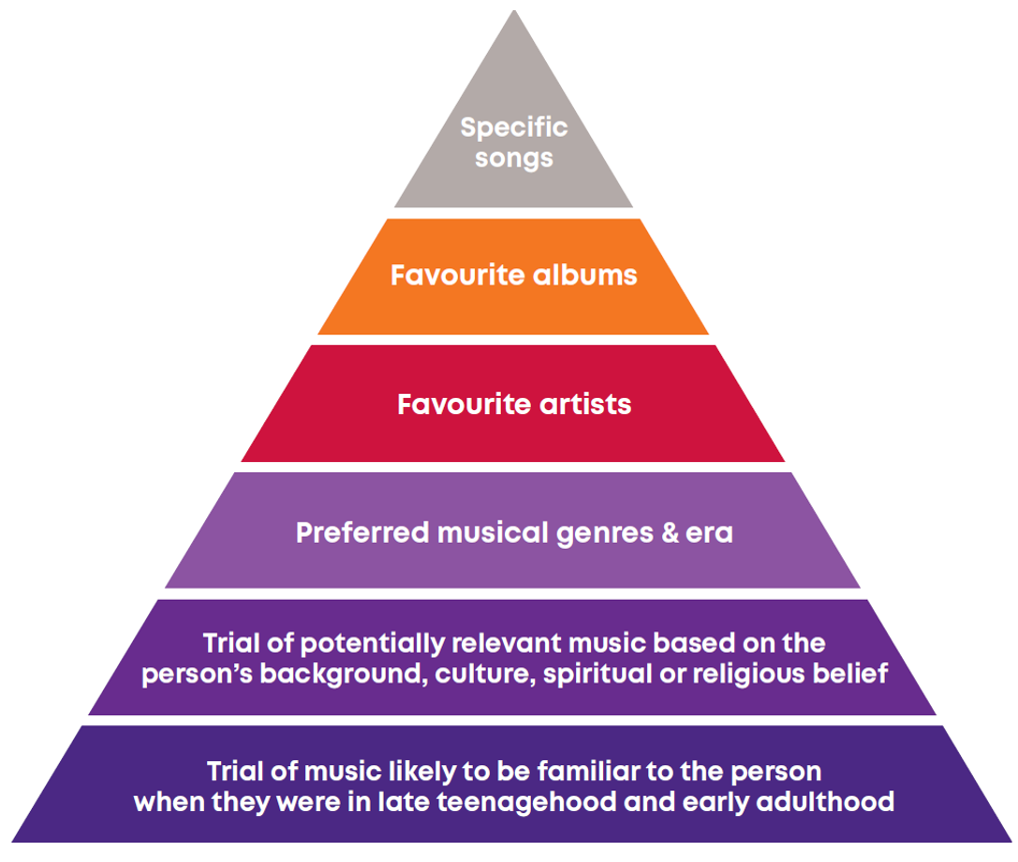
The Dementia Centre).
Family and friends may be able to supplement this information, and in many cases may be the primary source of information where the person with dementia is no longer able to communicate verbally or is unable to remember specific songs or artists. Family members can be asked whether they have access to any CDs, cassette tapes or records that the person owns, as these could be incorporated into the playlist.
This is also an opportunity to ask the family member whether they are aware of any music that the person has reacted negatively to in the past, or perhaps any music that would be associated with any negative or emotionally intense memories for that person. Where it is difficult to get information either from the person themselves or from family and friends, it is possible to simply play music to the person and observe their reaction. Music covering a wide range of genres could be played to the individual to see what they respond best to. A good place to start can be trying music that was popular during the person’s ‘reminiscence bump’, which is the period of adolescence and early adulthood from approximately 12 to 30 years old, and in which our most meaningful and strongest memories tend to be formed. Appendix 5 contains a list of songs from the 1940’s through 1970’s that covers a wide range of genres. People not from an English-speaking background may particularly benefit from the use of music specific to the region in which they grew up.
Music that is personally significant to an individual or from a preferred genre will be more effective for managing moods and behaviour in people with dementia
If the person with dementia is limited in their ability to speak or communicate verbally, a positive reaction can also be gauged through body language, such as tapping foot/hand in time with the music, heading nodding, singing, humming, smiling, and the like. Negative reactions may be evident from crying, distressed vocalisations or facial expressions, restlessness, and shallow breathing. The strength of memories associated with particular songs can also be rated to determine which songs are most meaningful to the individual (see Appendix 6).
Chapter 3 summary
- Music is most effective when it is personally significant to the listener. E.g., a song they positively associate with a person or memory.
- Where possible, try to ask the person with dementia to think of personally significant music. Alternatively, when necessary, you can ask their family, friends, or carers.
- Where specific information is not available, another approach is to carefully observe how they respond to different songs, genres, starting with music from that person’s ‘reminiscence bump’ (music that was popular when they were aged approximately 12 to 30 years old). Appendix 5 contains suggested songs and genres.
- The information in this chapter relates to the third part of ‘Step 1’ on the Music for Dementia website.