Western Sydney University: The MARCS institute for brain, behaviour & development
Login

Log in to your account

Forgot your password?

-+=
  • Home
  • My Profiles
  • Help
    • Spotify Help
      • Getting Started with Spotify
      • Create playlists
      • Find playlists
      • Save and recover playlists
      • Collaborative playlists
      • Playlist privacy
      • Explicit content
      • Now Playing
      • Listen offline
    • Alternative Music Services
  • The Guide
    • How to Use these Guidelines
    • The Relationship between Music and Dementia: An Overview
    • Quick Reference Guide to Music Selection for People with Dementia
    • Chapter 1 – Assessment of Vulnerability to Negative Responses
    • Chapter 2 – Identifying Key Changes to Behaviour
    • Chapter 3 – Personal Taste and Preferences
    • Chapter 4 – Selecting Music for Playlists: How Music Features Interact with Particular Symptoms
    • Chapter 5 – Creating and using playlists: making choices about technology
    • Chapter 6 – Monitoring and Managing Adverse Reactions
    • References
    • Appendix 1 – Vulnerability Scale template
    • Appendix 2 – Global Deterioration Scale, and the Seven Stages of Dementia
    • Appendix 3 – Changes in Behaviour template
    • Appendix 4 – Determining Music Preferences template
    • Appendix 5 – Examples of Songs by Genre, Tempo, & Decade
    • Appendix 6 – Template for Rating Strength of Response to Music
    • Appendix 7 – Listening Diary & Music Usage Plan template
  • Alternative Music Services
  • Playlist Examples
  • Templates
  • Feedback
  • Contact
Menu
  • Home
  • My Profiles
  • Help
    • Spotify Help
      • Getting Started with Spotify
      • Create playlists
      • Find playlists
      • Save and recover playlists
      • Collaborative playlists
      • Playlist privacy
      • Explicit content
      • Now Playing
      • Listen offline
    • Alternative Music Services
  • The Guide
    • How to Use these Guidelines
    • The Relationship between Music and Dementia: An Overview
    • Quick Reference Guide to Music Selection for People with Dementia
    • Chapter 1 – Assessment of Vulnerability to Negative Responses
    • Chapter 2 – Identifying Key Changes to Behaviour
    • Chapter 3 – Personal Taste and Preferences
    • Chapter 4 – Selecting Music for Playlists: How Music Features Interact with Particular Symptoms
    • Chapter 5 – Creating and using playlists: making choices about technology
    • Chapter 6 – Monitoring and Managing Adverse Reactions
    • References
    • Appendix 1 – Vulnerability Scale template
    • Appendix 2 – Global Deterioration Scale, and the Seven Stages of Dementia
    • Appendix 3 – Changes in Behaviour template
    • Appendix 4 – Determining Music Preferences template
    • Appendix 5 – Examples of Songs by Genre, Tempo, & Decade
    • Appendix 6 – Template for Rating Strength of Response to Music
    • Appendix 7 – Listening Diary & Music Usage Plan template
  • Alternative Music Services
  • Playlist Examples
  • Templates
  • Feedback
  • Contact
  • Home
  • Create an account
  • Log In
  • Log Out
  • My Profiles
  • Help
    • Spotify Help
      • Getting Started with Spotify
      • Create playlists
      • Find playlists
      • Save and recover playlists
      • Collaborative playlists
      • Playlist privacy
      • Explicit content
      • Now Playing
      • Listen offline
    • Alternative Music Services
  • The Guide
    • How to Use these Guidelines
    • The Relationship between Music and Dementia: An Overview
    • Quick Reference Guide to Music Selection for People with Dementia
    • Chapter 1 – Assessment of Vulnerability to Negative Responses
    • Chapter 2 – Identifying Key Changes to Behaviour
    • Chapter 3 – Personal Taste and Preferences
    • Chapter 4 – Selecting Music for Playlists: How Music Features Interact with Particular Symptoms
    • Chapter 5 – Creating and using playlists: making choices about technology
    • Chapter 6 – Monitoring and Managing Adverse Reactions
    • References
    • Appendix 1 – Vulnerability Scale template
    • Appendix 2 – Global Deterioration Scale, and the Seven Stages of Dementia
    • Appendix 3 – Changes in Behaviour template
    • Appendix 4 – Determining Music Preferences template
    • Appendix 5 – Examples of Songs by Genre, Tempo, & Decade
    • Appendix 6 – Template for Rating Strength of Response to Music
    • Appendix 7 – Listening Diary & Music Usage Plan template
  • Alternative Music Services
  • Playlist Examples
  • Templates
  • Feedback
  • Contact
Menu
  • Home
  • Create an account
  • Log In
  • Log Out
  • My Profiles
  • Help
    • Spotify Help
      • Getting Started with Spotify
      • Create playlists
      • Find playlists
      • Save and recover playlists
      • Collaborative playlists
      • Playlist privacy
      • Explicit content
      • Now Playing
      • Listen offline
    • Alternative Music Services
  • The Guide
    • How to Use these Guidelines
    • The Relationship between Music and Dementia: An Overview
    • Quick Reference Guide to Music Selection for People with Dementia
    • Chapter 1 – Assessment of Vulnerability to Negative Responses
    • Chapter 2 – Identifying Key Changes to Behaviour
    • Chapter 3 – Personal Taste and Preferences
    • Chapter 4 – Selecting Music for Playlists: How Music Features Interact with Particular Symptoms
    • Chapter 5 – Creating and using playlists: making choices about technology
    • Chapter 6 – Monitoring and Managing Adverse Reactions
    • References
    • Appendix 1 – Vulnerability Scale template
    • Appendix 2 – Global Deterioration Scale, and the Seven Stages of Dementia
    • Appendix 3 – Changes in Behaviour template
    • Appendix 4 – Determining Music Preferences template
    • Appendix 5 – Examples of Songs by Genre, Tempo, & Decade
    • Appendix 6 – Template for Rating Strength of Response to Music
    • Appendix 7 – Listening Diary & Music Usage Plan template
  • Alternative Music Services
  • Playlist Examples
  • Templates
  • Feedback
  • Contact

Help

Spotify Help
Alternative Music Services
Contact
How to create an acccount

You can create an account on this page: Create an account

You will be logged into the site straight away and you will be sent an email with your username details.

How to log in

You can log in to the website on this page: Log In

If you’ve forgotten your password you can use this form to reset it: Reset your password

How to make a new profile

In order to use the tools in this website you will need to make a new profile for each person with dementia.

The survey answers, music recommendations, listening diary, strength of response ratings and music usage plan are stored for each person.

  1. To make a new profile, go to ‘My Profiles’
  2. Fill out the profile name and date of birth for the profile under ‘Step 1: Questionnaire’.
  3. You need to complete the full questionnaire for the profile to be created.
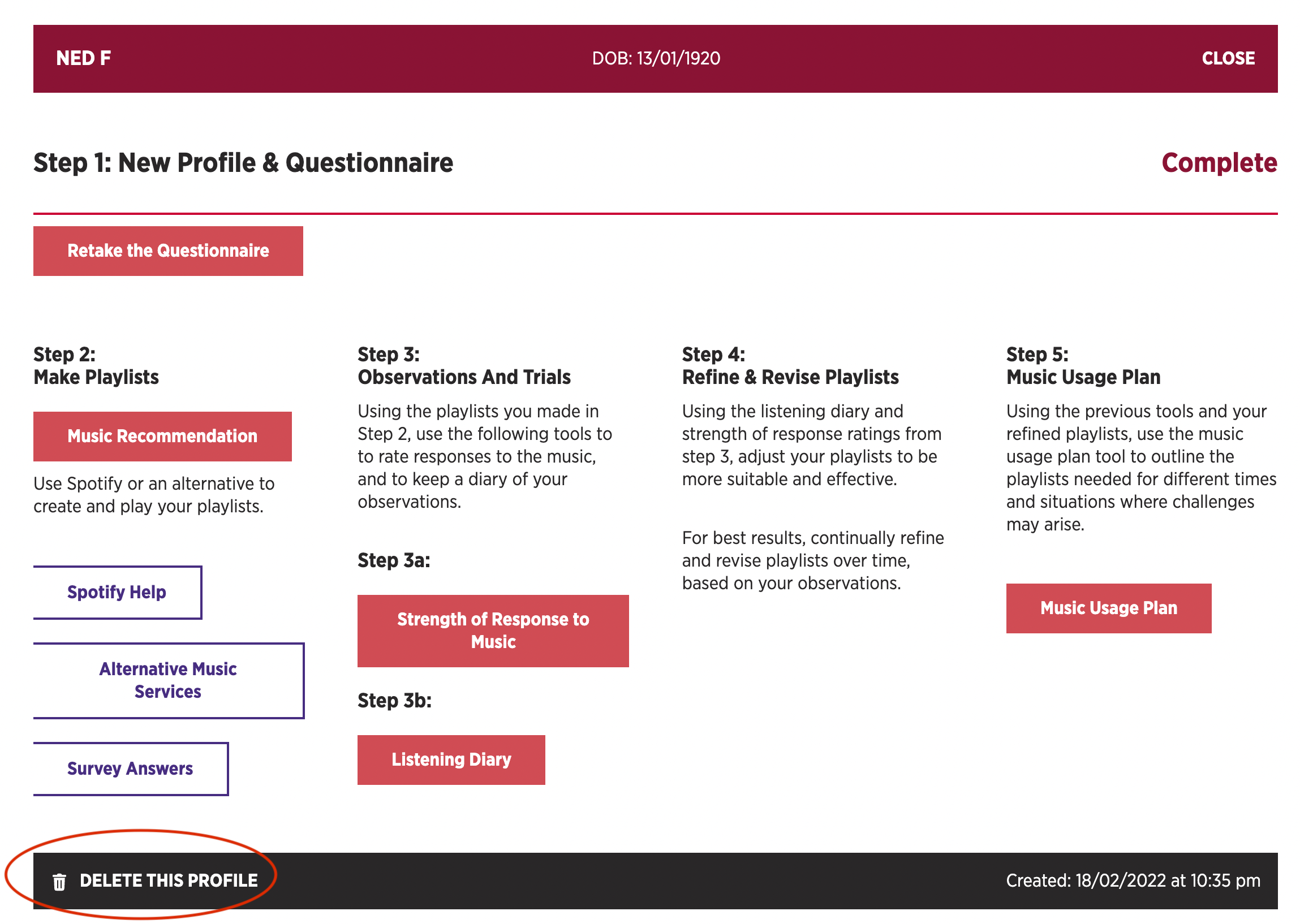
How to delete profiles

To delete a created profile, click on the profile name on ‘My Profiles’

The delete button is located in a black bar at the bottom of the profile tools.
How to get music recommendations

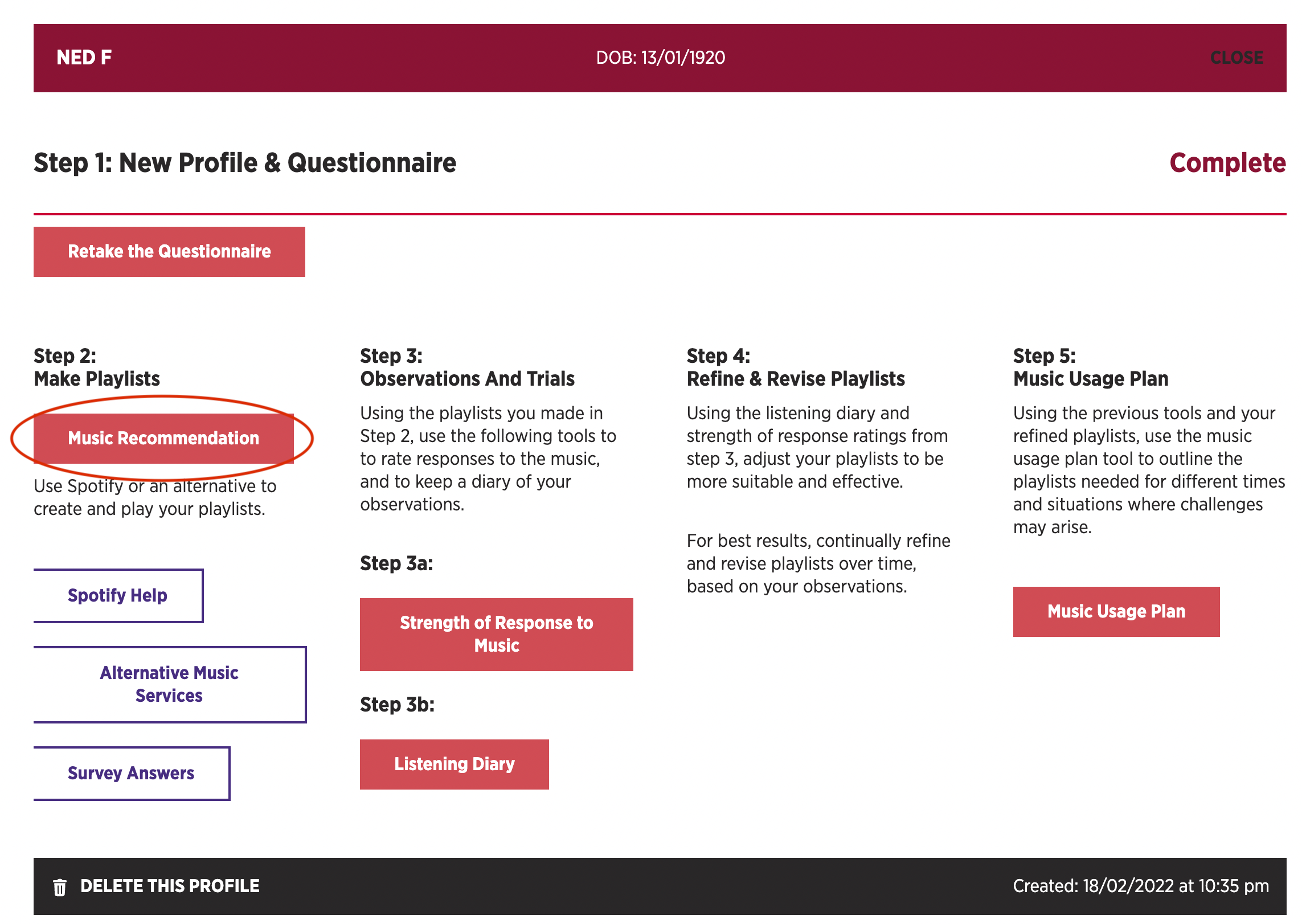
To get music recommendations, you need to create a profile and complete the questionnaire in full located on the ‘My Profiles’ page.

Once a new profile is created, a link to their music recommendations will be available under their name.
How to rate responses to music

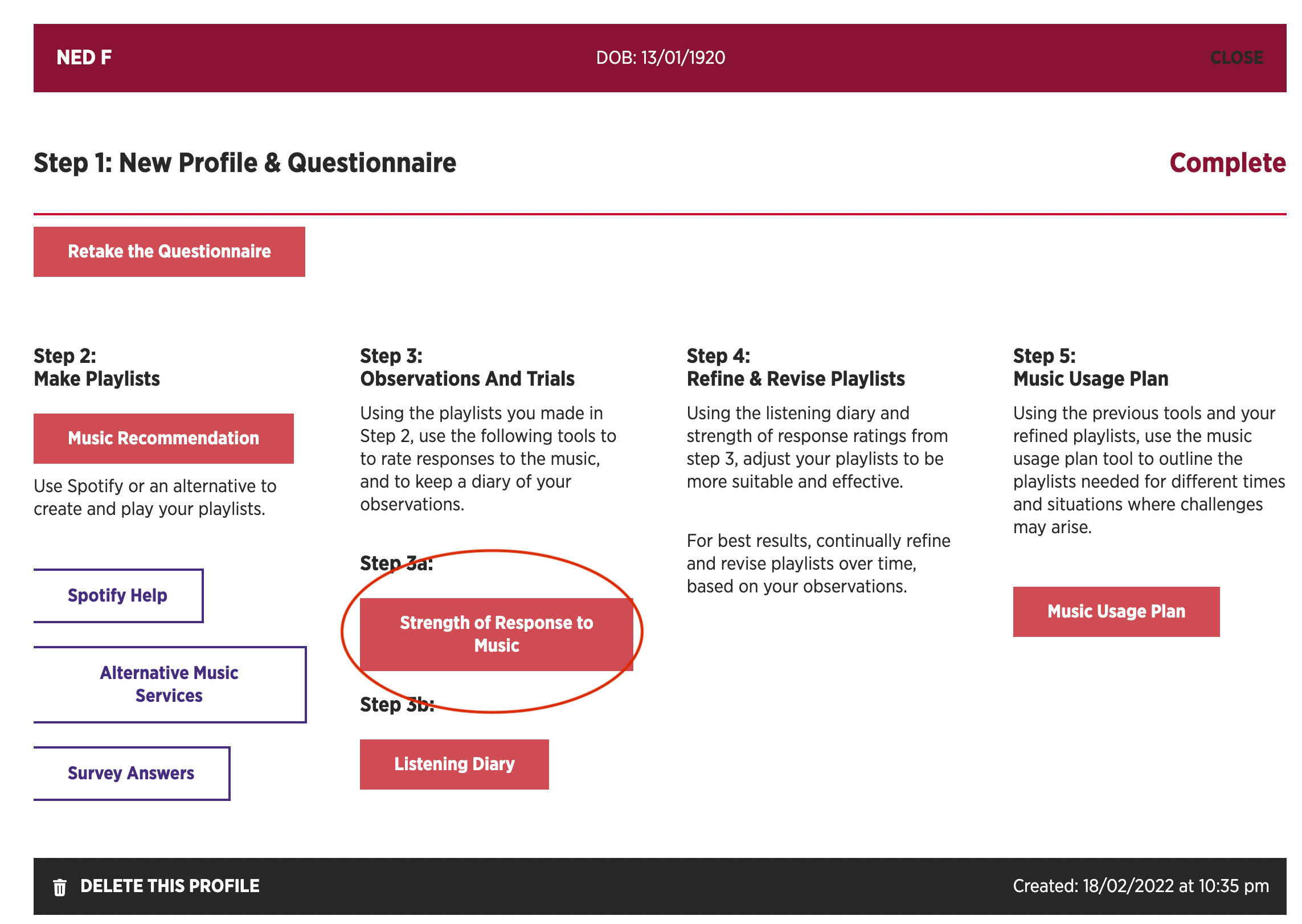
Once the Questionnaire has been completed there will be a link to rate the profile’s responses to music under their name on the ‘My Profiles’ page
How to keep a listening diary

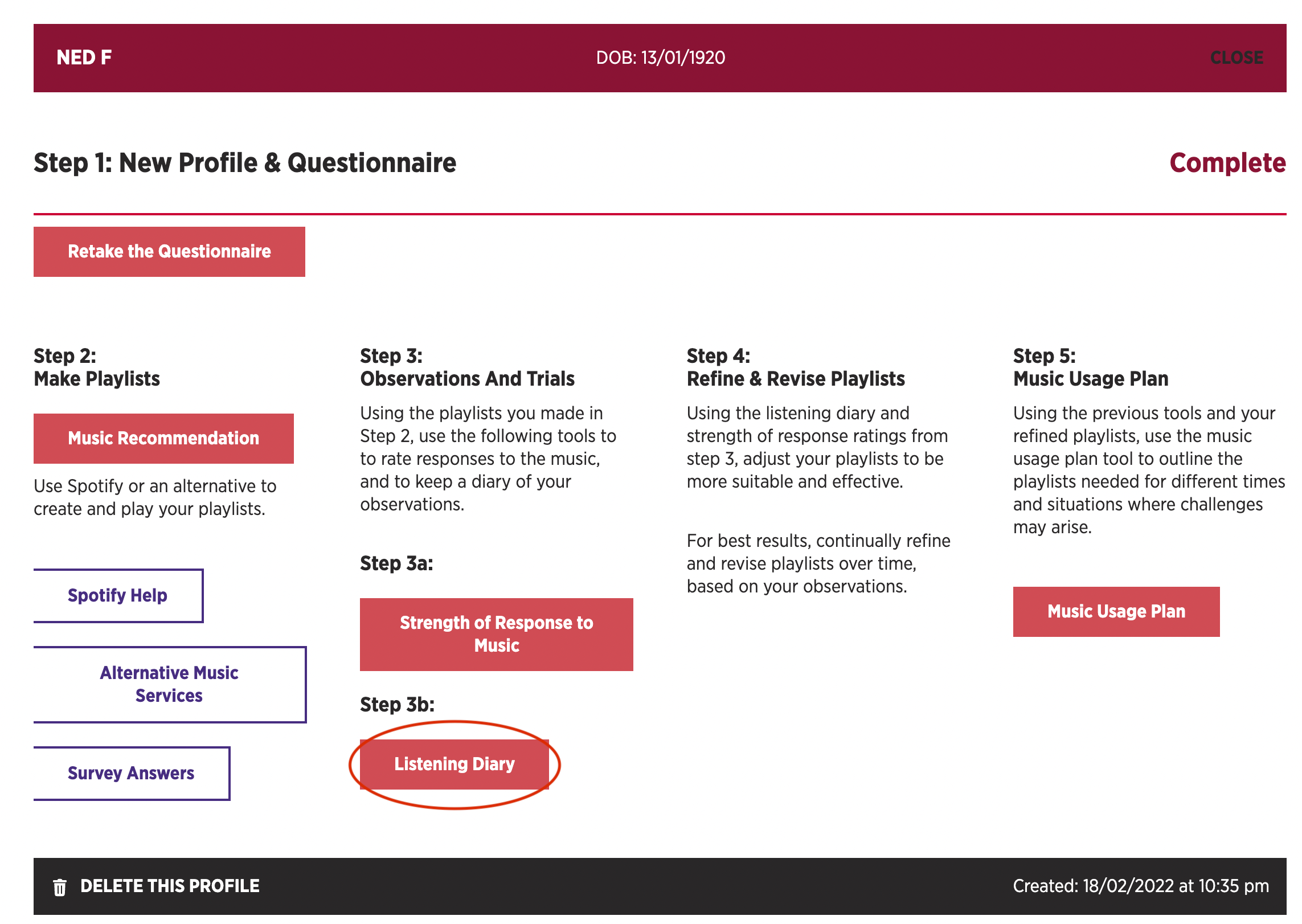
Once the Questionnaire has been completed there will be a link to keep a listening diary for each profile under their name on the ‘My Profiles’ page
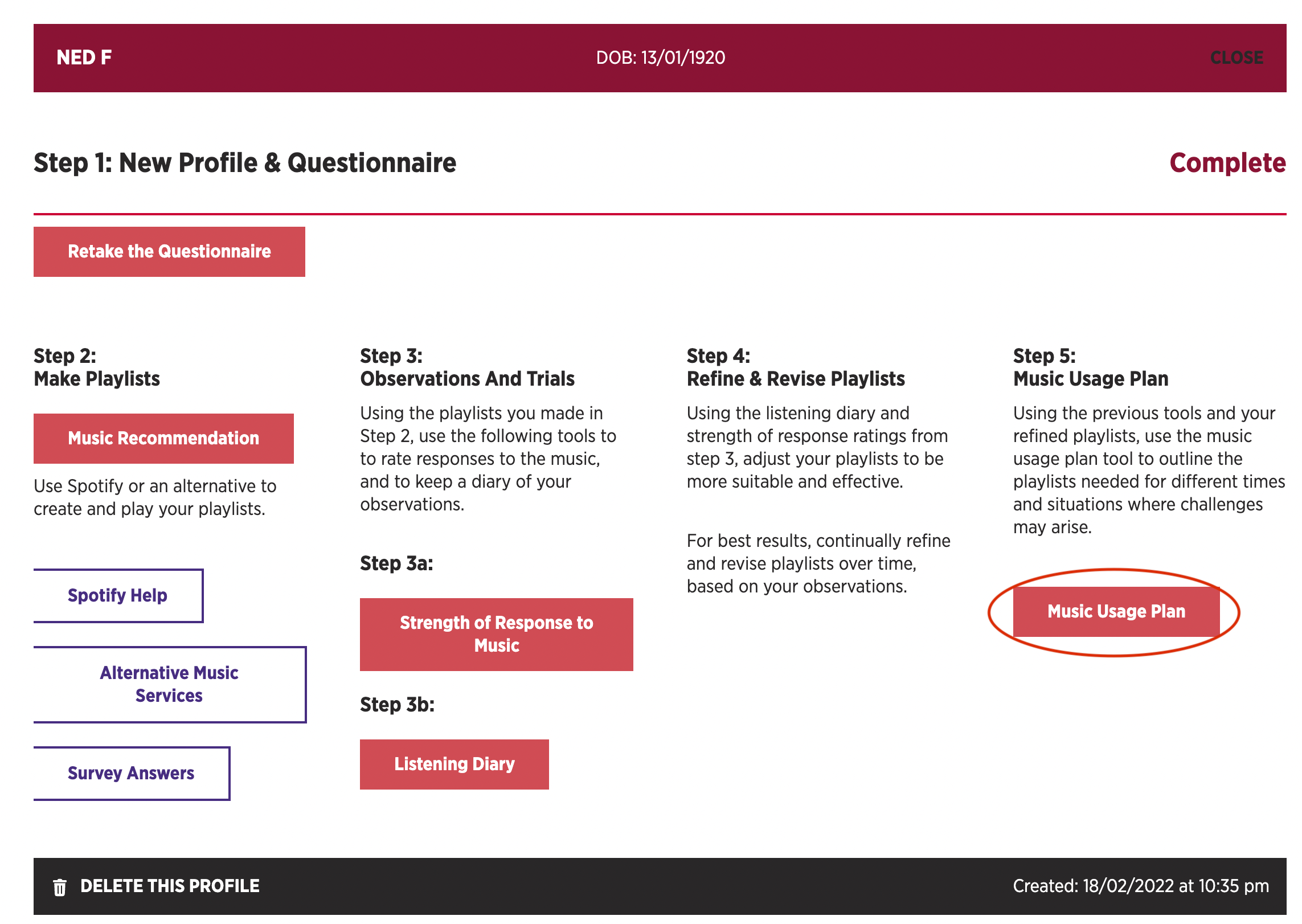
How to create a music usage plan

Once the Questionnaire has been completed there will be a link to create a music usage plan for each profile under their name on the ‘My Profiles’ page.
Privacy Policy

© Dr Sandra Garrido 2021

website design & build by e-h.com.au